Firenze Déco: Atmospheres of the Roaring Twenties in Florence
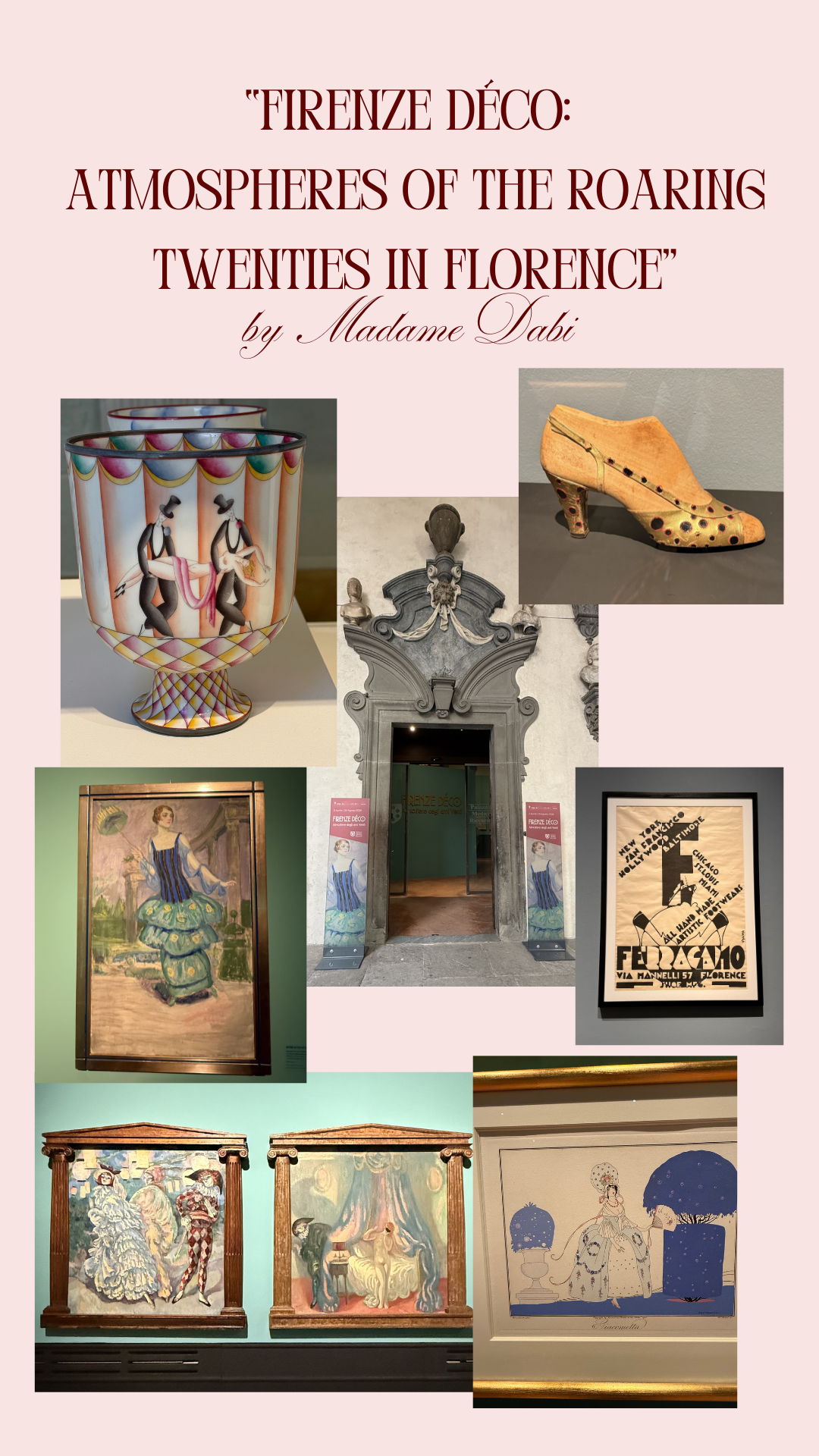
During my recent stay in Florence, I visited the exhibition Firenze Déco. Atmosfere degli anni Venti at Palazzo Medici Riccardi. These pauses are essential for me, moments to disconnect from routine, recharge creatively and surround myself with beauty, objects, and atmospheres that continue to influence my work long after returning home.
The exhibition explores the role of Florence in shaping Italian Art Déco during the 1920s, bringing together ceramics, fashion, textiles, advertising graphics, decorative arts, and design objects from one of the most elegant and experimental decades of the twentieth century. The exhibition particularly highlights Florence as a refined center for applied arts and international taste during the interwar years.
I particularly loved the first section dedicated to the relationship between Florence and Paris, and to the imagery of Commedia dell’Arte masks, a recurring subject within Déco visual culture. Artists such as Umberto Brunelleschi, Alfredo Müller, and Gino Carlo Sensani developed a visual language inspired by the gallant eighteenth century and by traditional Italian theatrical characters, themes that became widely present in 1920s illustration, graphics, and decorative arts. In particular, Umberto Brunelleschi remains one of the illustrators who most influenced my own rococo sensibility.
Among the pieces that stayed with me most were the ceramics designed by Gio Ponti for Richard-Ginori. Their balance between classical elegance and modern geometry still feels remarkably contemporary.
Another detail I loved was the section dedicated to the early universe of Salvatore Ferragamo. In particular, an elegant shoe from the 1920s displayed beside original advertising graphics immediately captured my attention. There is something fascinating about seeing the beginnings of what would later become one of Italy’s defining luxury houses: the elongated silhouettes, the theatrical femininity, the visual language of early fashion advertising. The exhibition also traces the origins of Florentine fashion and craftsmanship through Ferragamo’s early production and period posters.
What makes Firenze Déco particularly interesting is that it does not present Art Déco only as decoration, but as a complete aesthetic language, one that shaped interiors, fashion, objects, graphic design, and even the idea of modern femininity itself.
If you have the chance to visit it this Summer, it is a small exhibition worth seeing.
With love,
Madame.
*All images are taken by me.
